Motion profiles
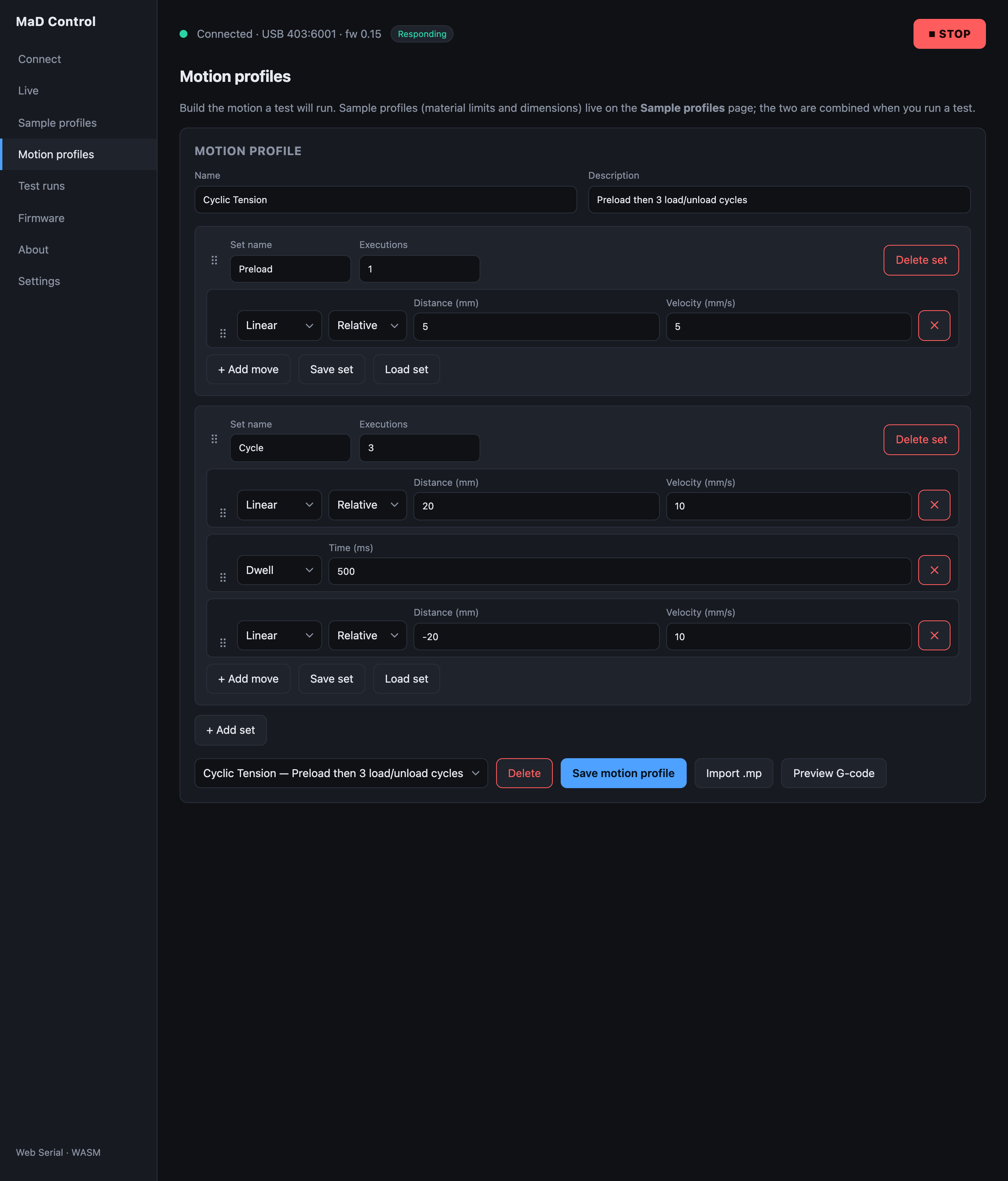
A motion profile defines what the machine does during a test — a sequence of moves, grouped into repeatable sets. You build it on the Motion Profiles screen.
Structure
A motion profile has a name and description, and contains one or more sets. Each set has:
- a name,
- an executions count (how many times the set repeats),
- and an ordered list of moves.
Both sets and moves are drag-reorderable (grab the handle on the left). You can add and delete sets and moves freely.
Move types
| Type | Parameters | What it does |
|---|---|---|
| Linear | position + velocity | A controlled pull or return to a position. |
| Dwell | time (ms) | Hold position for a fixed time. |
| Waveform | a waveform type, then that type's parameters | Sine: amplitude, frequency — one cycle that starts and ends at rest where the gantry is, swinging out to twice the amplitude: up first for a positive amplitude, down first for a negative one. Sigmoid: position, velocity, acceleration — an S-curve move: like a linear move, but its acceleration rises and falls smoothly instead of switching on and off. Chirp: amplitude, start and end frequency, duration — a sine whose frequency sweeps steadily from start to end, for seeing how a material responds across loading rates in one run. The duration is rounded to whole cycles so it ends at rest where it started. |
Every position is absolute: sample extension in mm, measured from zero length.
Repeating a sine. One sine move is one cycle. Put it in a set on its own and use the set's executions for the number of cycles; back-to-back cycles run as one continuous wave. The gantry's position when it starts is the bottom (or, for a negative amplitude, the top) of the stroke, so to oscillate around a position, first move one amplitude below (or above) it. A back-and-forth at constant speed (a triangle wave) is a set of two linear moves, out and back, repeated the same way.
For the Waveform move, the app shows the live peak velocity, peak acceleration and duration, and warns you if they exceed the machine's limits.
A sine runs as the machine's own canned cycle, so long cyclic runs continue unattended. It is a cosine from rest: starting and ending at a peak, where the wave's own speed is zero, means the gantry follows it exactly from the first moment, with no extra moves before or after.
A sigmoid is sent as a chain of short straight moves whose speeds follow the S-curve; the machine carries its speed from one into the next, so it runs as one smooth motion. It takes a little longer than a linear move at the same velocity and acceleration, because its acceleration builds up gradually.
A waveform the machine cannot physically deliver — too fast for its amplitude, say — is refused by the machine rather than run at a reduced amplitude, so a specimen never sees a gentler loading than the report claims. The app warns before the run when a waveform, or any other move, goes beyond the machine's limits (see Running a test). Straight and sigmoid moves faster than the machine allows are not refused: they run at its speed and acceleration limits, so they take longer than written. Hand-written G-code can also hold at either peak and load faster than it unloads; see Waveform motion control.
Preview the motion
Click Preview G-code to see a distance-vs-time chart of exactly what the machine will do, along with the instructions that will be sent:
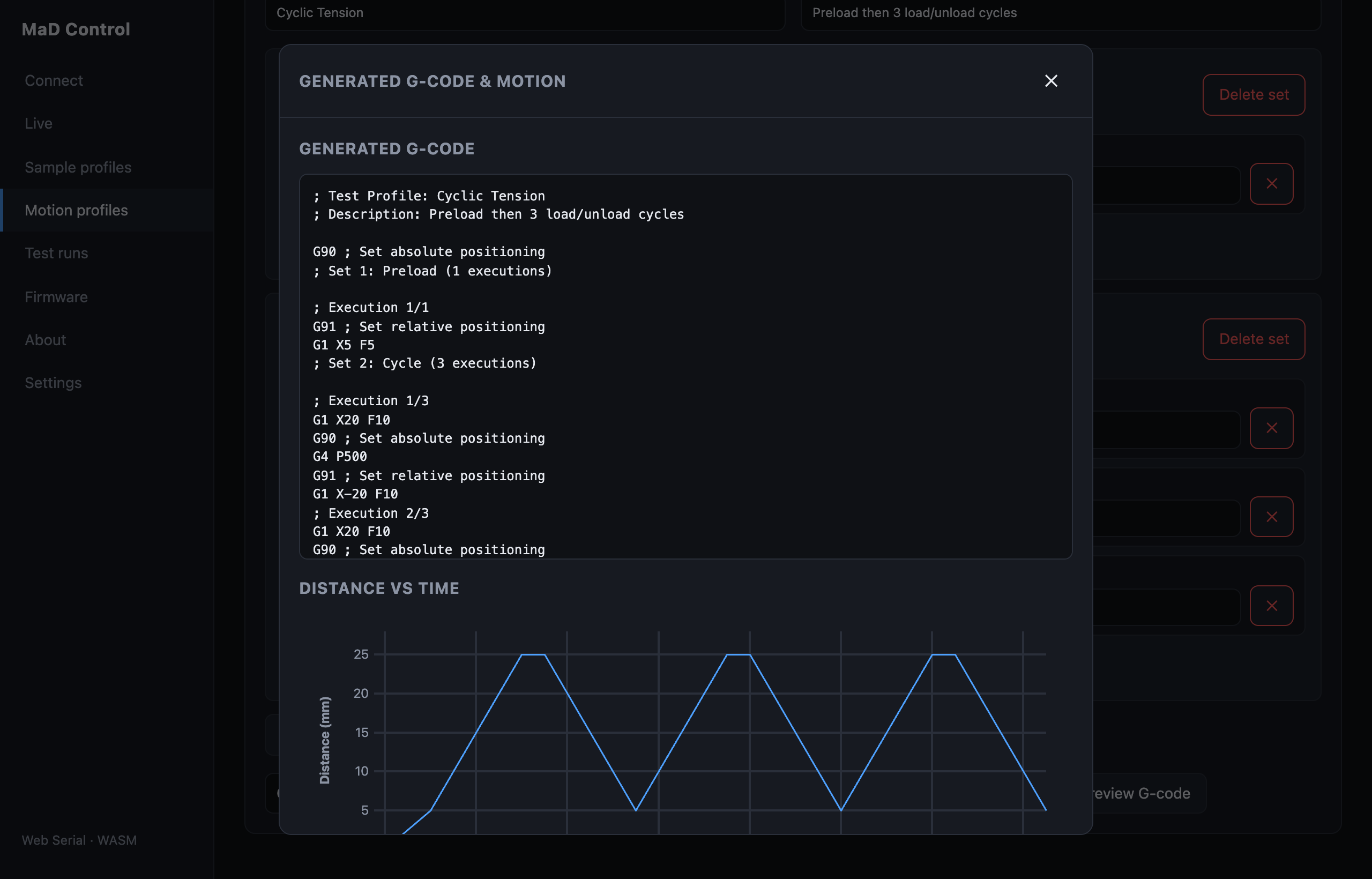
This is a good habit before running an unfamiliar profile — the chart makes an accidental over-long pull or an inverted direction obvious at a glance.
Saving, loading, importing
- Save motion profile stores it in your data folder; it then appears in the Load saved profile… dropdown.
- You can also Save / Load individual Sets, so a reusable set (e.g. a cyclic block) can be shared across profiles.
- Import loads a profile from a
.mpfile — see file formats. - The save button shows Saved ✓ when it worked, and leaving with unsaved changes asks first.
Old motion profiles must be rebuilt
Profiles saved before this format (relative moves; waveforms with a cycle count, centre, holds, skew, phase or a triangle shape) are refused on load, import and run, with a message naming the move. They are not converted: read as the current format they would mean something else (a relative +10 mm move would drive to 0 mm), so rebuild them.